


The AI Organisation: How Artificial Intelligence is Redrawing the Org Chart
 By Bryan Turner


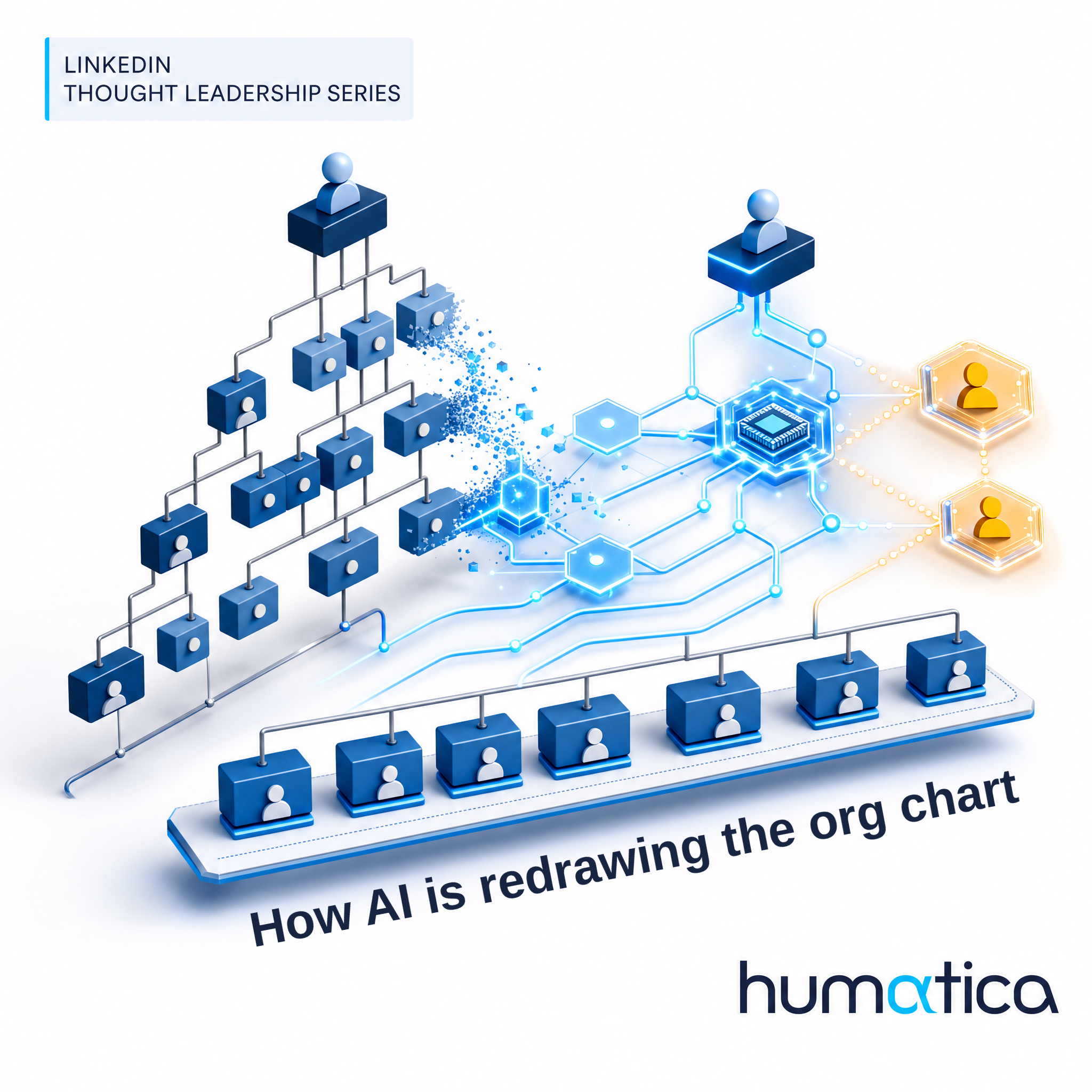
Every significant technological shift in economic history has ultimately changed the shape of organisations — not just the tools they use, but their structures, hierarchies, and the distribution of decision-making authority. The assembly line concentrated production and created factory management structures. The computer enabled the scale-up of administrative functions and the rise of process-intensive bureaucracies. Enterprise software standardised and centralised information flows, reinforcing functional hierarchies.
AI is a coordination technology — perhaps the most powerful coordination technology ever created. And like every major coordination technology before it, it will change the economics of organisational design in ways that are beginning to become visible and that will accelerate significantly over the next five years.
The Coordination Cost Theory of Organisational Structure
The economist Ronald Coase observed that organisations exist to reduce the transaction costs of coordination. The shape of any organisation — its number of layers, its span of control, its degree of centralisation — reflects the cost of coordinating information flows, monitoring performance, and making decisions at each level.
AI dramatically reduces these coordination costs. When AI can synthesise performance data from across a business unit and present a clear exception report to a manager in seconds, the value of having a layer of middle management whose primary job was to perform that synthesis diminishes. When AI can monitor adherence to process across thousands of transactions simultaneously, the need for supervisory layers whose primary function was oversight changes.
This is not a future scenario. In the organisations at the leading edge of AI deployment, it is already happening. Management layers that once existed to aggregate, filter, and escalate information are finding their core function automated. The question is not whether this will affect most organisations — it will — but whether leaders will design the transition intentionally or allow it to happen by attrition.
The Compression of Middle Management
The structural pressure on middle management is the most significant and least discussed organisational implication of AI. This is not primarily about the elimination of roles — though some elimination is inevitable — it is about the transformation of what management means.
The traditional middle manager performed four functions: information aggregation (collecting data from direct reports and synthesising it upward), performance monitoring (tracking adherence to targets and process), workflow coordination (managing handoffs, priorities, and resource allocation), and people development (coaching, feedback, and capability building). AI is now capable of performing the first three of these functions at a level that matches or exceeds human performance in many contexts. It cannot yet perform the fourth.
This creates a clear direction of travel for the management role: away from information processing and toward human development, judgment, and leadership. The managers who thrive in AI-augmented organisations will be those who are excellent coaches, decisive decision-makers in genuinely ambiguous situations, and skilled at the relational aspects of leading teams through change. Those who built their value primarily on information synthesis and process monitoring face a genuine challenge.
Expanding Spans of Control
As AI takes on the monitoring, synthesis, and coordination functions that historically limited how many people a manager could effectively oversee, the optimal span of control increases. In early AI-augmented deployments, we are seeing evidence of spans of control widening from the typical six-to-eight range to ten-to-fifteen in functions where AI tools are well integrated.
The implication for organisational structure is significant. If spans double, an organisation with five layers of management needs only four. If spans triple — which is theoretically plausible in highly AI-augmented knowledge work — three layers may suffice. The resulting organisations are flatter, faster, and cheaper to run. They also require a different quality of manager: fewer, but better.
New Organisational Units and Roles
While AI is compressing some roles, it is creating others. Every significant enterprise AI deployment requires new capabilities that most organisations do not currently have at scale: AI product management (defining what AI systems should do and measuring whether they do it), AI quality assurance (validating outputs and managing failures), AI governance (oversight, risk management, and ethical review), and AI change management (helping humans adapt to working alongside AI systems).
Leading organisations are addressing this partly through dedicated AI centres of excellence and partly through embedding AI expertise directly into functional teams. The right answer is likely a hybrid — a central capability for standards, governance, and the most complex technical challenges, combined with embedded AI fluency across every function.
Designing the Transition
The organisations that will navigate this transition most successfully are those that approach it as a deliberate design challenge rather than allowing organic drift. This means conducting a rigorous analysis of which management roles are primarily performing functions that AI will automate, developing a clear view of the manager of the future and what capabilities they need, designing genuine career pathways for the transition, and communicating honestly with the people whose roles are changing.
It also means resisting the temptation to simply cut management layers without redesigning the organisation around them. Flatter structures require different processes, different spans, different governance, and different leadership capabilities. The organisations that get this right will be more agile, more cost-effective, and better positioned to compete in an AI-native world. The ones that cut without designing will create fragility, not agility.
Related Insights
AI and Competitive Advantage: Why the Moat Is the Data, Not the Model
Every board strategy conversation about AI now includes a version of the same question: how do we use AI to get ahead, rather than just…
Read more
AI Risk: The 10 Things Every Board Should Know (and Most Don’t)
Corporate governance has always lagged behind the risks it is meant to manage. Boards develop oversight frameworks for risks after those risks have become embedded…
Read more
The CFO’s AI Imperative: From Efficiency Gain to Strategic Transformation
Finance has always been an early adopter of technology — from double-entry bookkeeping to spreadsheets to ERP to cloud-based analytics. And finance has always been…
Read more
Subscribe to our Monthly Newsletter and other News Updates
Receive our news and valuable perspectives on organizational effectiveness each month.