


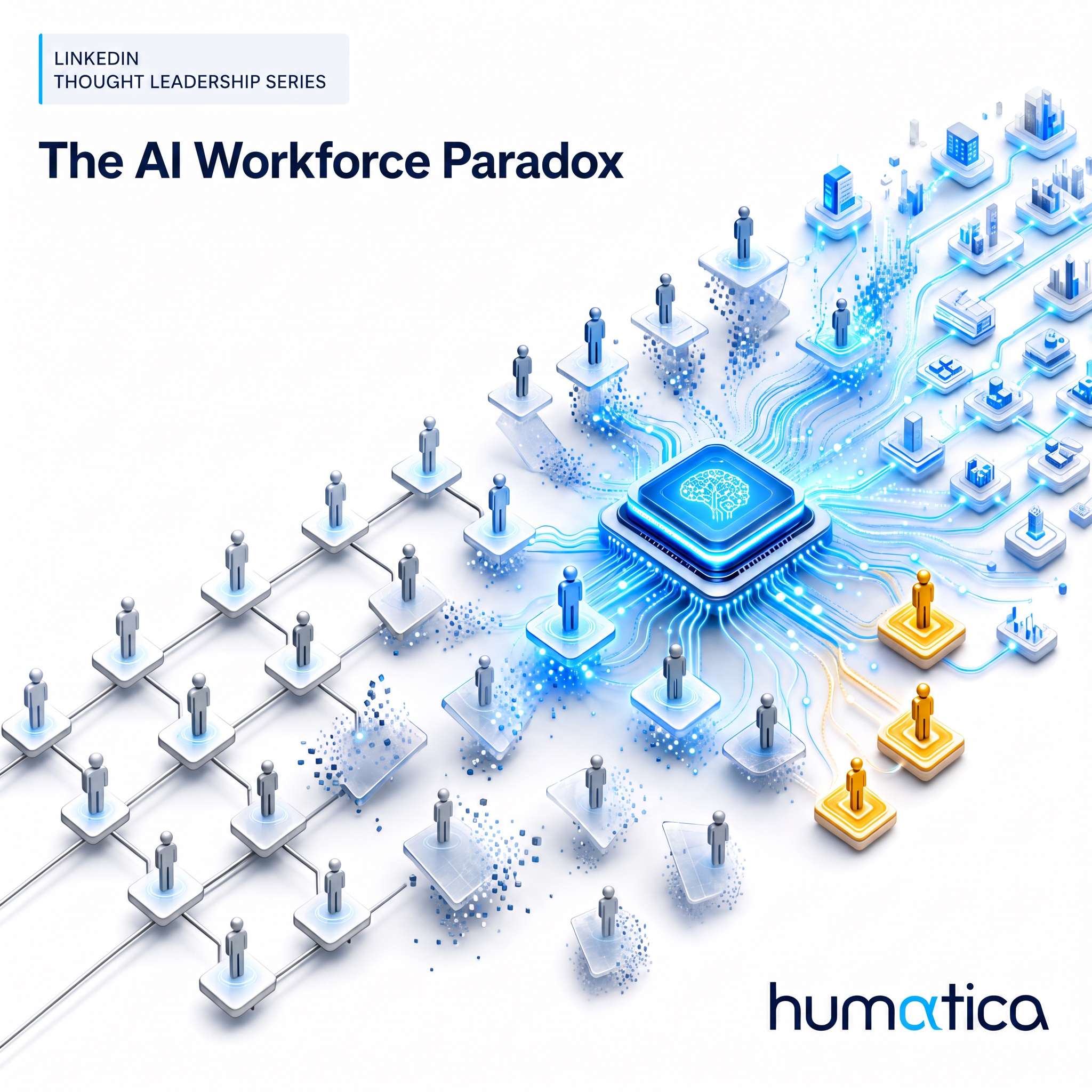
The AI Workforce Paradox: More Productivity, More Uncertainty, and a Generation of Workers Who Don’t Know Where They Stand
 By Bryan Turner


The evidence that AI improves individual productivity is now overwhelming. Across dozens of controlled studies, knowledge workers with AI tools consistently outperform those without — writing faster, analysing more thoroughly, producing higher-quality outputs across a remarkable range of tasks. A Stanford study of software developers found 55% productivity improvements. A Harvard Business School study of management consultants found 25% higher quality ratings on AI-assisted work. The productivity case for AI is settled.
And yet every major workforce survey in 2025 and 2026 shows that a substantial majority of employees — across sectors, levels, and geographies — report significant anxiety about AI’s impact on their employment, their career trajectory, and the value of the skills they have spent years developing. In the most recent Edelman survey, 69% of workers expressed concern that AI would make some or all of their skills obsolete.
These two realities coexist. They are both true. And the organisations that are successfully navigating AI transformation are those that hold both in mind simultaneously — capturing the productivity gains while taking seriously the human costs of uncertainty and managing them with deliberate care.
The Hidden Phenomenon: Quiet AI
One of the most revealing trends emerging from workplace AI research is what has been termed ‘quiet AI’ — the widespread use of AI tools by employees to enhance their performance, without disclosing this to their managers or colleagues. Studies suggest that between 40% and 60% of knowledge workers are regularly using AI tools in their work, while a significant proportion are doing so without the knowledge or explicit sanction of their employers.
Quiet AI creates several distinct risks. First, it creates hidden quality dependencies: when an employee’s outputs are partly AI-generated and their manager does not know this, the organisation cannot appropriately validate, govern, or build upon that AI use. Second, it creates uneven development: employees using AI quietly may be producing better outputs now while their underlying skills atrophy — a problem that becomes visible only when AI is not available or when outputs are challenged. Third, it creates governance exposure: AI use that bypasses data handling policies can inadvertently expose confidential information to third-party models.
The root cause of quiet AI is almost always the same: employees believe that disclosing AI use will be viewed negatively — as cheating, as evidence of inadequacy, or as a flag for potential redundancy. This is a leadership and cultural failure, not an employee failure.
What Employees Actually Need
The most consistent finding from research into employee attitudes to AI is that people do not primarily need protection from the truth about AI’s implications. They need clarity, honesty, and a credible plan.
The organisations managing the human dimension of AI transformation most effectively are doing four things. They are communicating candidly about which roles and tasks AI will affect, and on what timeframe — rather than offering reassuring platitudes that employees do not believe. They are investing genuinely in reskilling, not as a compliance exercise but as a real commitment to helping people develop the skills that will be valuable in an AI-augmented world. They are redesigning roles actively to reflect AI’s changing capabilities, rather than leaving people in roles whose function has been partially automated without updating the role definition or performance expectations. And they are creating psychological safety around AI use — normalising, encouraging, and recognising AI adoption rather than creating conditions where it goes underground.
This Is a CEO Problem, Not an HR Problem
Perhaps the most important insight for organisations navigating this challenge is that the human dimension of AI transformation cannot be delegated to HR. It is, at its core, a question of how the organisation treats its people in a period of significant and genuine uncertainty — and that is a question that only visible, committed CEO leadership can resolve.
Employees are watching closely how their leaders talk about AI. They notice whether AI is discussed only in terms of efficiency and cost, or whether the human dimensions are addressed with equal seriousness. They notice whether the commitment to reskilling is backed by real investment or confined to aspirational language in the annual report. They notice whether the leaders advocating AI transformation are themselves learning to use AI tools and adapting their own practices.
The organisations that will unlock the full productivity potential of AI are those whose people trust that the organisation is genuinely committed to their future — not just to the technology’s potential. That trust is built by leaders, not by HR programmes. And it is the most important determinant of whether AI transformation succeeds.
Reframing the Conversation
The most damaging framing in the AI workforce conversation is the binary of ‘jobs AI will take’ versus ‘jobs AI won’t take’. This framing generates anxiety without generating insight, because it treats AI impact as a categorical question when in reality it operates at the level of tasks, not jobs.
Almost every job in a modern organisation contains tasks that AI will automate, tasks that AI will augment, and tasks that will remain distinctly human. The leadership challenge is not to predict which jobs survive — it is to redesign jobs around this changing task composition, to reskill people for the tasks that become more important, and to communicate this transformation with the honesty and care that people deserve. The organisations that do this well will have more engaged, more capable, and more loyal workforces than those that do not — and that will be a decisive competitive advantage in an AI-enabled world.
Related Insights
Why 80% of AI Pilots Never Scale — and What the Successful 20% Do Differently
The AI pilot graveyard is large, and it is growing. Across the organisations we have worked with and the research we have reviewed, the pattern…
Read more
AI and Competitive Advantage: Why the Moat Is the Data, Not the Model
Every board strategy conversation about AI now includes a version of the same question: how do we use AI to get ahead, rather than just…
Read more
AI Risk: The 10 Things Every Board Should Know (and Most Don’t)
Corporate governance has always lagged behind the risks it is meant to manage. Boards develop oversight frameworks for risks after those risks have become embedded…
Read more
Subscribe to our Monthly Newsletter and other News Updates
Receive our news and valuable perspectives on organizational effectiveness each month.