


The AI Reality Check: Cutting Through the Hype to What’s Actually Happening in Business
 By Bryan Turner


Ask ten business leaders how their AI transformation is progressing, and nine will tell you it’s going well. Ask their finance directors how much measurable value AI has added to the P&L, and the conversation changes quickly. This is the central paradox of AI in business in 2026: enormous enthusiasm, accelerating investment, and a persistent gap between experimentation and genuine enterprise transformation.
This article is not an attempt to pour cold water on AI — the technology is real, the potential is extraordinary, and the pace of development is unlike anything in recent business history. It is, however, an attempt to be honest about where most organisations actually sit on the AI journey — and what distinguishes the minority that are genuinely capturing AI value from the majority that are still, in important ways, figuring it out.
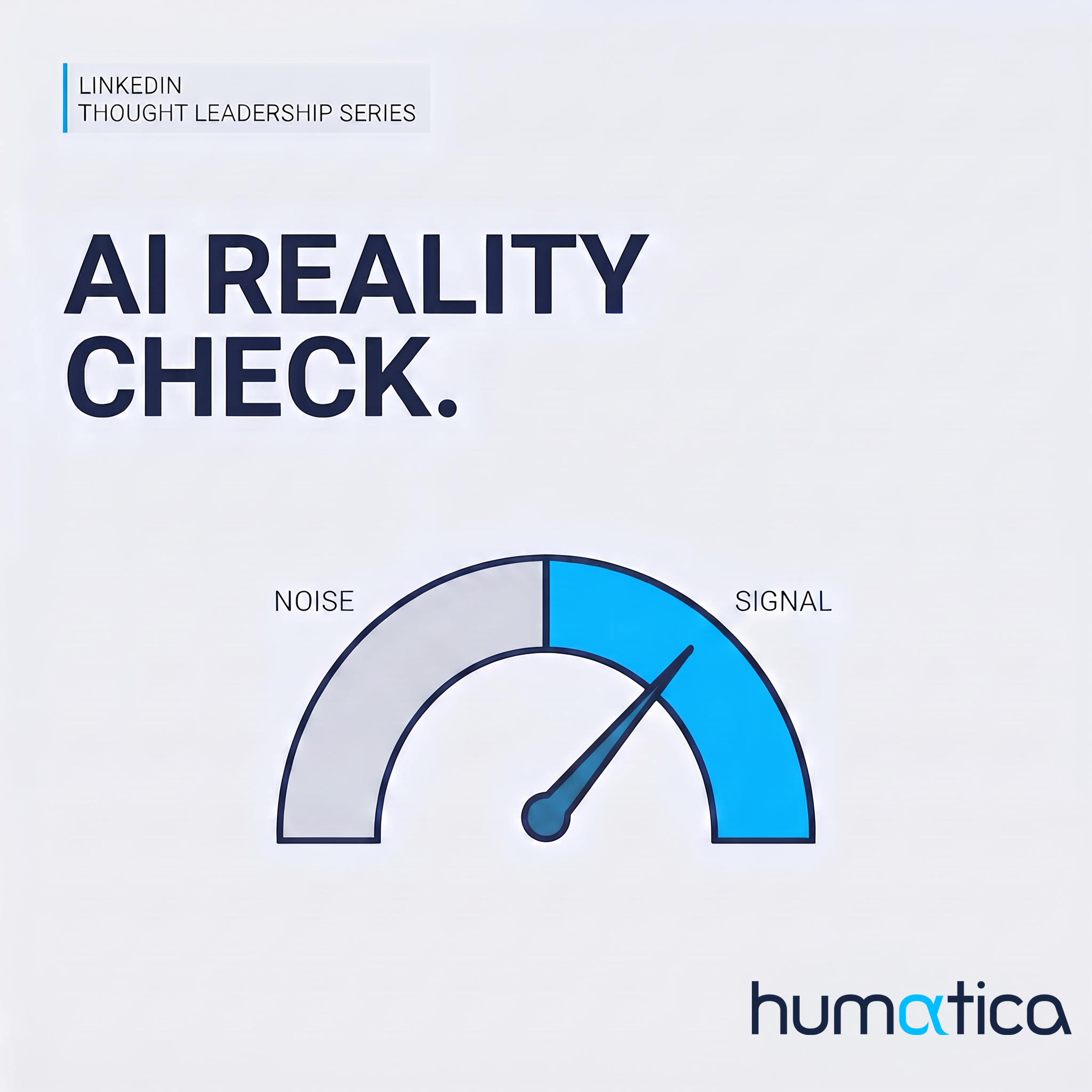
Separating Signal from Noise
The AI hype cycle has been running at full intensity for the past three years, and the signal-to-noise ratio has deteriorated as a result. Every major software vendor has rebranded every product with an AI label. Every board presentation includes an AI slide. Every annual report references the company’s AI ambitions.
Beneath the noise, however, something genuinely significant is happening. The productivity evidence from organisations that have moved from experimentation to deployment is now substantial and credible. Studies from McKinsey, MIT, and Stanford consistently show 20-40% productivity improvements in knowledge work tasks when AI tools are well implemented. In software development, the empirical evidence for AI coding assistants is particularly strong — multiple randomised controlled trials show 35-55% improvements in coding speed. In legal document review, AI has demonstrated the ability to perform at human-expert level in a fraction of the time.
These are real results. But they come from specific applications in specific contexts, with specific implementation conditions. The mistake is to extrapolate from these headline numbers to an assumption that transformation is simply a matter of deploying an AI platform and waiting for productivity to appear.
The Maturity Spectrum
The most useful framework for thinking honestly about organisational AI progress is a maturity spectrum. At one end sit the AI-native organisations — typically born in the last decade, with data infrastructure, engineering culture, and operating models built from the ground up for AI. These organisations are not on an AI transformation journey; AI is simply how they operate. At the other end sit the AI-unaware organisations — still running on legacy systems, with fragmented data, limited technical capability, and leadership teams that have not yet made AI a strategic priority.
The vast majority of organisations — established enterprises across every sector — sit somewhere in the middle of this spectrum. They have made AI investments. They have AI pilots running. They may have deployed AI tools in one or two functions. But they have not yet achieved the state of enterprise-wide AI deployment that is genuinely changing their operating model, their cost structure, or their competitive position.
The critical insight is that this middle ground is becoming increasingly uncomfortable. The gap between AI-native competitors and AI-laggard incumbents is widening, and it is widening faster than most boards have appreciated. The organisations in the middle are facing a narrowing window to close that gap before it becomes decisive.
What Genuine Transformation Actually Looks Like
Genuine AI transformation is identifiable by three characteristics. First, it is measurable in financial and operational metrics — not in the number of AI tools deployed or the number of employees who have completed AI training, but in cost per transaction, cycle time, error rate, revenue per employee, or margin. If you cannot point to the P&L impact, you are not yet in transformation territory.
Second, genuine AI transformation has changed how work is organised. The organisational structure, the processes, and the roles have adapted to exploit AI capabilities — not just added AI tools on top of unchanged working practices. The most common failure mode in AI deployment is using AI to do the old job faster, rather than redesigning the job around AI’s capabilities.
Third, genuine transformation is self-reinforcing. The more data the AI systems process, the better they get. The more the organisation learns about how to exploit AI, the faster it can deploy new capabilities. There is a compounding dynamic at work in the AI leaders that is absent in the followers.
Three Questions Every CEO Should Answer
Rather than positioning your organisation on a maturity framework, we suggest a simpler test: three questions that every CEO should be able to answer clearly and specifically.
First: where is AI currently creating measurable financial impact in our organisation, and what is the magnitude? Not where it has potential — where it is delivering now, and in numbers.
Second: what is the single biggest organisational or cultural barrier preventing us from scaling our AI initiatives beyond their current scope? Not the technology barriers — those are almost always solvable — but the organisational ones: data quality, change resistance, governance gaps, leadership capability.
Third: what is the AI capability of our most formidable competitor in 18 months, and what is our plan if they are significantly ahead of where we will be? The competitive dimension of AI is under-discussed in most strategy conversations, but it may be the most important question of all.
If these questions are difficult to answer with confidence and precision, that is itself useful information. It suggests that AI has not yet been treated with the strategic seriousness it warrants. The organisations that will succeed are those that close that gap — and they are best placed to do so by being honest about where they currently stand.
The Right Disposition
None of this is an argument for pessimism about AI. Quite the opposite. The case for urgency is strong. The evidence for AI’s potential value in business is now overwhelming. The organisations that are leading are demonstrating that transformation is not just theoretically possible — it is practically achievable.
But it is achievable through deliberate, rigorous, organisationally-grounded effort — not through technology deployment alone. The AI reality check is not a reason to slow down. It is a reason to get more serious, more strategic, and more honest about the gap between where you are and where you need to be.
Related Insights
AI Risk: The 10 Things Every Board Should Know (and Most Don’t)
Corporate governance has always lagged behind the risks it is meant to manage. Boards develop oversight frameworks for risks after those risks have become embedded…
Read more
The CFO’s AI Imperative: From Efficiency Gain to Strategic Transformation
Finance has always been an early adopter of technology — from double-entry bookkeeping to spreadsheets to ERP to cloud-based analytics. And finance has always been…
Read more

Building the AI-Ready Organisation: Why Technology is the Easiest Part
When most organisations begin an AI readiness assessment, they start with technology. Do we have a modern cloud infrastructure? A unified data platform? Access to…
Read more
Subscribe to our Monthly Newsletter and other News Updates
Receive our news and valuable perspectives on organizational effectiveness each month.