


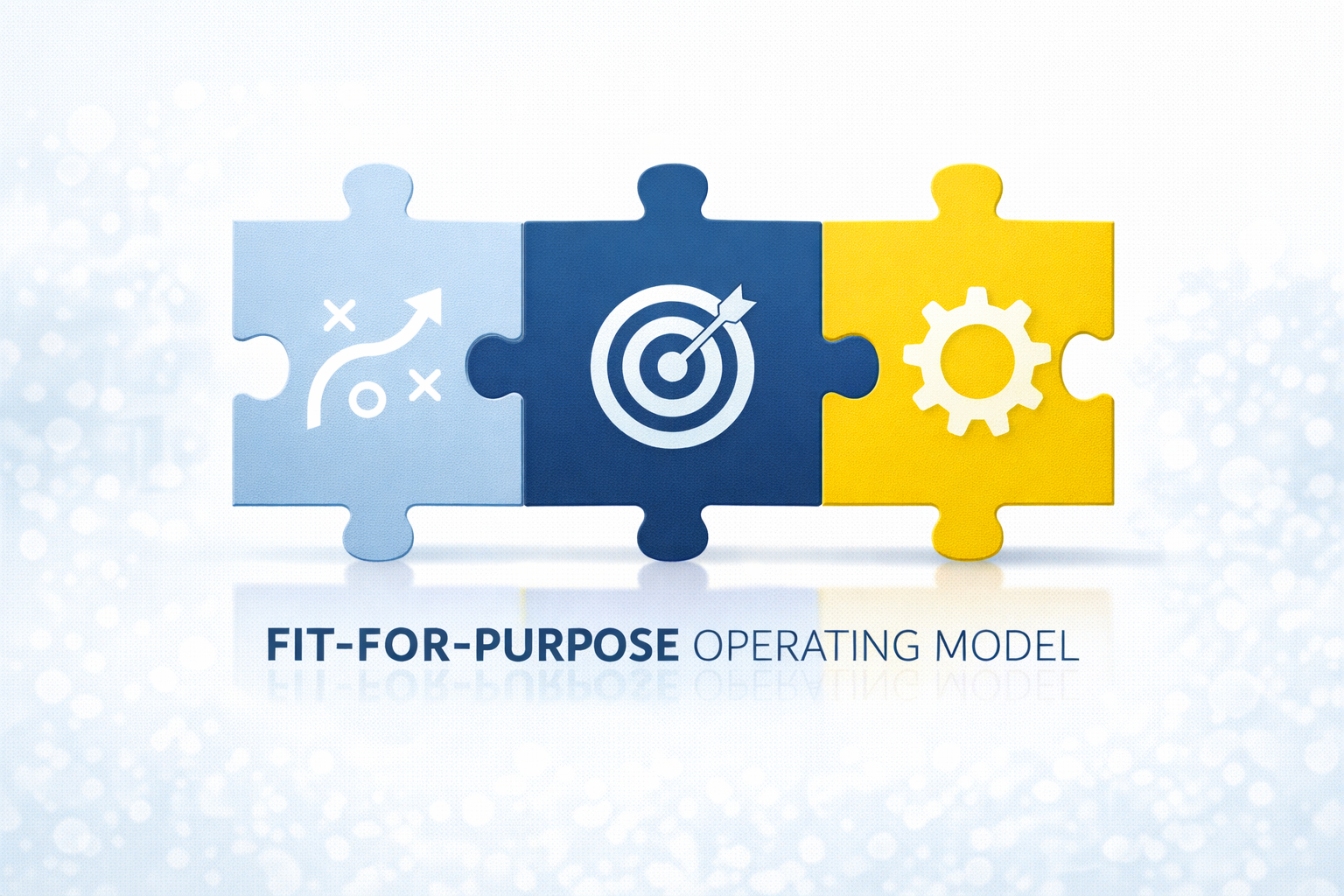
Why a Fit-for-Purpose Operating Model is Now a Strategic Imperative
 By Claudio Limacher


In many organizations, strategy promises growth, efficiency, and innovation—but day-to-day execution tells a different story. Decisions drag. Silos persist. Accountability blurs. Leaders work harder without seeing the expected results. In most cases, the root cause is not the strategy itself, but the operating model that sits beneath it. As companies scale, transform, or face new competitive pressures, past structures and ways of working simply stop supporting what the business is trying to achieve. When the operating model is no longer fit for purpose, frictions build silently until financial performance suffers. [1], [2]
A Target Operating Model (TOM) is the blueprint that connects strategy to execution. It defines how an organization creates value: how decisions are made, how teams collaborate, how roles are structured, and how technology supports the flow of work. While org-charts describe who reports to whom, the operating model describes how work actually happens day to day. When this “how” is misaligned with the strategic ambitions of the business, even the best plans struggle to take off. [3], [4], [5]
Today’s environment makes TOM alignment more important than ever. Shifts in technology, new investor expectations, digital disruption, and the accelerating impact of AI mean that operating models age faster than in the past. Structures designed for stability are suddenly expected to deliver agility. Consolidated teams, built for scale, are asked to collaborate across boundaries. Leaders inherit processes that no longer match the company’s goals. The result: strategy–execution gaps, duplicated work, delays, and leadership teams spending more energy on firefighting than on advancing the business. [1], [6]
Yet a well-designed operating model can be a powerful multiplier. When roles are clear, decision rights are streamlined, governance is simple, and teams collaborate effectively, organizations can dramatically accelerate execution—improving speed, quality, and accountability. Research shows that companies with aligned operating models can improve execution pace by up to 10x and lift both productivity and customer satisfaction. The right TOM not only supports today’s strategy—it creates resilience and adaptability for tomorrow. [3]
But creating a great TOM on paper is not enough. The real challenge lies in implementation. Many TOM initiatives fail because leaders underestimate the changes required in behaviors, capabilities, systems, and metrics. Without a compelling case for change, genuine engagement of the organization, and clear alignment of KPIs and incentives, even well-designed models fall short. Successful TOM redesigns require thoughtful change management, leadership alignment, rigorous project discipline, and transparent communication. And increasingly, they require a perspective on how AI and automation are reshaping roles, workflows, and governance at their core. [7], [6], [8]
Given the escalating complexity of modern business, operating model redesign is becoming a “must-have” necessity, rather than a one-off transformation. Companies are revisiting their TOM assumptions more frequently and ensuring that changes are fast, robust, and tied to tangible performance outcomes.
This initial article sets the stage for a three-part deep dive into designing and implementing a fit-for-purpose TOM:
Part I – Recognizing When Your Operating Model No Longer Fits
Part II – Designing a TOM That Truly Enables Strategy
Part III – Implementing the TOM: Turning Design into Lasting Results
Together, the series provides a practical roadmap for leaders seeking to turn strategy into results quickly, sustainably, and at scale.
Sources
[1] Strategy& (PwC) (n.d.), Capabilities-Driven Strategy + Growth https://www.strategyand.pwc.com/gx/en/unique-solutions/capabilities-driven-strategy/operating.html
[2] Shilu Acharya, Ritec Group (2023), 5 Signs Your Operating Model Isn’t Serving You https://www.ritecgroup.com/post/5-signs-your-operating-model-isn-t-serving-you
[3] Brooke Weddle & Deepak Mahadevan, McKinsey & Company (2023), What is an operating model and why does it matter? https://www.mckinsey.com/featured-insights/mckinsey-explainers/what-is-an-operating-model
[4] Accelare (n.d.), Org Chart vs. Operating Model: Which Method is Best for Your Business? https://www.accelare.com/blog/org-chart-vs-operating-model-which-method-is-best-for-your-business
[5] Capstera (n.d.), Target Operating Model https://www.capstera.com/target-operating-model/
[6] Hunter Kafcsak & Alexis Pugh, Propeller (2023), Common Operating Model Pitfalls & How to Avoid Them https://propeller.com/blog/why-operating-models-fail-and-how-to-get-yours-back-on-track
[7] Don Purdon (2023), The Impact of AI on Your Organisational Operating Model https://www.linkedin.com/pulse/impact-ai-your-organisational-operating-model-don-purdon-e7v8c
[8] Vibranium Bridge Strategy Consulting (2023), Reimagining Operating Models for an AI-Powered Economy https://www.vibraniumbridge.com/post/reimagining-operating-models-for-an-ai-powered-economy
Related Insights

AI Risk: The 10 Things Every Board Should Know (and Most Don’t)
Corporate governance has always lagged behind the risks it is meant to manage. Boards develop oversight frameworks for risks after those risks have become embedded…
Read more
The CFO’s AI Imperative: From Efficiency Gain to Strategic Transformation
Finance has always been an early adopter of technology — from double-entry bookkeeping to spreadsheets to ERP to cloud-based analytics. And finance has always been…
Read more
Building the AI-Ready Organisation: Why Technology is the Easiest Part
When most organisations begin an AI readiness assessment, they start with technology. Do we have a modern cloud infrastructure? A unified data platform? Access to…
Read more
Subscribe to our Monthly Newsletter and other News Updates
Receive our news and valuable perspectives on organizational effectiveness each month.