


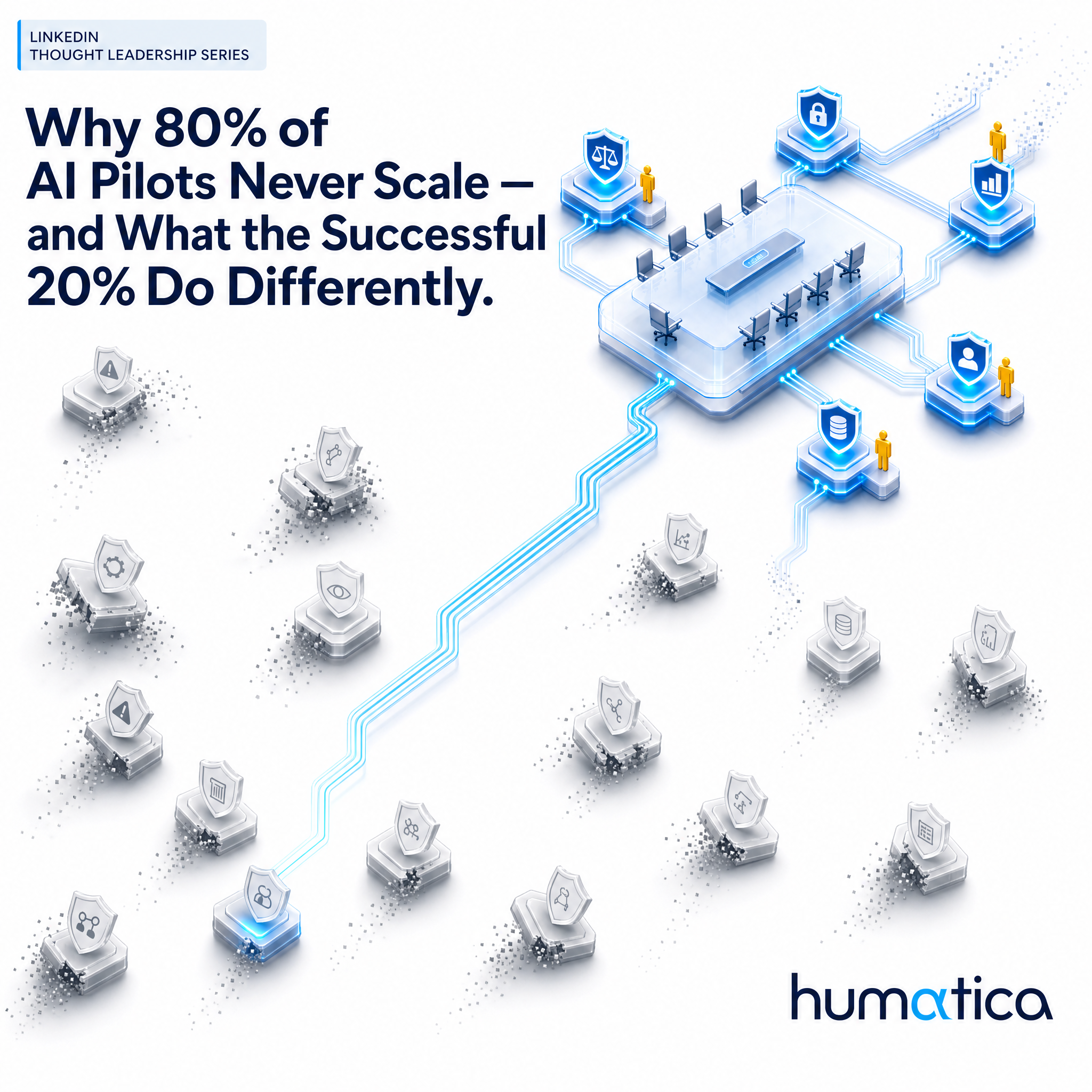
Why 80% of AI Pilots Never Scale — and What the Successful 20% Do Differently
 By Bryan Turner


The AI pilot graveyard is large, and it is growing. Across the organisations we have worked with and the research we have reviewed, the pattern is remarkably consistent: an AI pilot is launched with genuine enthusiasm and appropriate resources. It produces impressive results in its controlled environment. It generates positive executive attention and a favourable internal review. And then — at the point where it should scale into production — it stalls. Sometimes it stalls visibly, killed by a governance process or a failed integration. More often it stalls quietly, as attention moves to the next initiative and the pilot drifts into a permanent semi-deployed state that delivers a fraction of its potential value.
The scale of this failure is significant. Multiple industry analyses suggest that fewer than 20% of AI pilots successfully reach full production deployment within 12 months of launch. Understanding why — and understanding what the successful 20% do differently — is one of the most important practical questions in AI implementation.
Failure Mode 1: The Demo Trap
The demo trap is the most common failure mode, and the most insidious. An AI system that performs impressively with clean, curated data in a controlled environment frequently fails to maintain that performance when it encounters the messy reality of production data, edge cases, and integration with legacy systems. The gap between demo performance and production performance is a function of data quality, model robustness, and edge case handling — and it is routinely underestimated during pilot design.
The solution is to deliberately design pilots around production conditions. The pilot environment should use real production data (with appropriate governance), should surface and stress-test edge cases, and should involve the people who will actually use the system in their normal working context. A pilot that succeeds in these conditions is genuinely ready to scale. A pilot that succeeds only in controlled conditions has not yet been properly tested.
Failure Mode 2: The Integration Abyss
AI systems create value by integrating with business processes — and business processes run on legacy technology that was not designed for AI integration. The technical gap between an AI system working in isolation and an AI system embedded in the organisation’s actual technology stack is frequently much larger than the pilot assumed. Integration projects that were budgeted at weeks take months; API connections that seemed straightforward reveal complex data format incompatibilities; security requirements add layers of complexity that the pilot architecture did not anticipate.
The mitigation is rigorous technical due diligence before pilot launch, not after. Understanding the integration requirements — and the realistic timeline and cost to meet them — is a precondition for a credible scale-up business case, not an afterthought.
Failure Mode 3: The Governance Bottleneck
Many organisations have risk, compliance, and procurement frameworks that were designed for conventional software systems and that were not designed for AI. When an AI application approaches the governance checkpoint before production deployment, it encounters questions that the existing framework cannot answer clearly: how do we categorise this risk? What testing and validation is required? Who has authority to approve a system that makes autonomous recommendations? The result is months of process delay while governance frameworks are extended — during which the project loses momentum, the sponsoring executive’s attention moves elsewhere, and the business case erodes.
The organisations that scale AI fastest are those that have proactively developed AI-specific governance frameworks before specific deployments reach the checkpoint, rather than designing governance in response to each individual deployment.
Failure Mode 4: The Organisational Immune Response
Every AI deployment that automates or significantly changes a human role will encounter resistance from the people whose roles are affected — sometimes overt, more often informal. A customer service team that has been told their work will be ‘augmented’ by an AI system has strong rational incentives to find the system’s flaws rather than its strengths, to route queries around it rather than through it, and to produce evaluations of its performance that are less than generous. This is not malice — it is a rational response to a perceived threat.
The organisations that navigate this effectively are those that involve the affected teams in the design and deployment of the AI system, rather than presenting it as a fait accompli. People who have helped shape a tool, who feel ownership of it, and who understand how it fits into a redesigned rather than reduced role, behave very differently from those who have had it imposed on them.
What the Successful 20% Do
The AI implementations that successfully scale share several characteristics. They have a business leader — not a technology leader — as the primary sponsor, with accountability for the business outcome rather than the technical implementation. They have a specific, measurable business outcome as the north star for the project, against which all design decisions are evaluated. They have involved end users in design and have treated user adoption as a first-class project deliverable, not an afterthought. They have done integration and governance due diligence before launch rather than after. And they have designed for scale from day one — piloting in conditions that reflect production reality rather than in protected environments.
None of these practices is technically complex. All of them require discipline, rigour, and the willingness to do the harder, less exciting work of organisation and process design alongside the more exciting work of AI development. That combination — AI ambition combined with implementation rigour — is the defining characteristic of the organisations that are converting AI potential into AI value.
Related Insights
AI and Competitive Advantage: Why the Moat Is the Data, Not the Model
Every board strategy conversation about AI now includes a version of the same question: how do we use AI to get ahead, rather than just…
Read more
AI Risk: The 10 Things Every Board Should Know (and Most Don’t)
Corporate governance has always lagged behind the risks it is meant to manage. Boards develop oversight frameworks for risks after those risks have become embedded…
Read more
The CFO’s AI Imperative: From Efficiency Gain to Strategic Transformation
Finance has always been an early adopter of technology — from double-entry bookkeeping to spreadsheets to ERP to cloud-based analytics. And finance has always been…
Read more
Subscribe to our Monthly Newsletter and other News Updates
Receive our news and valuable perspectives on organizational effectiveness each month.