


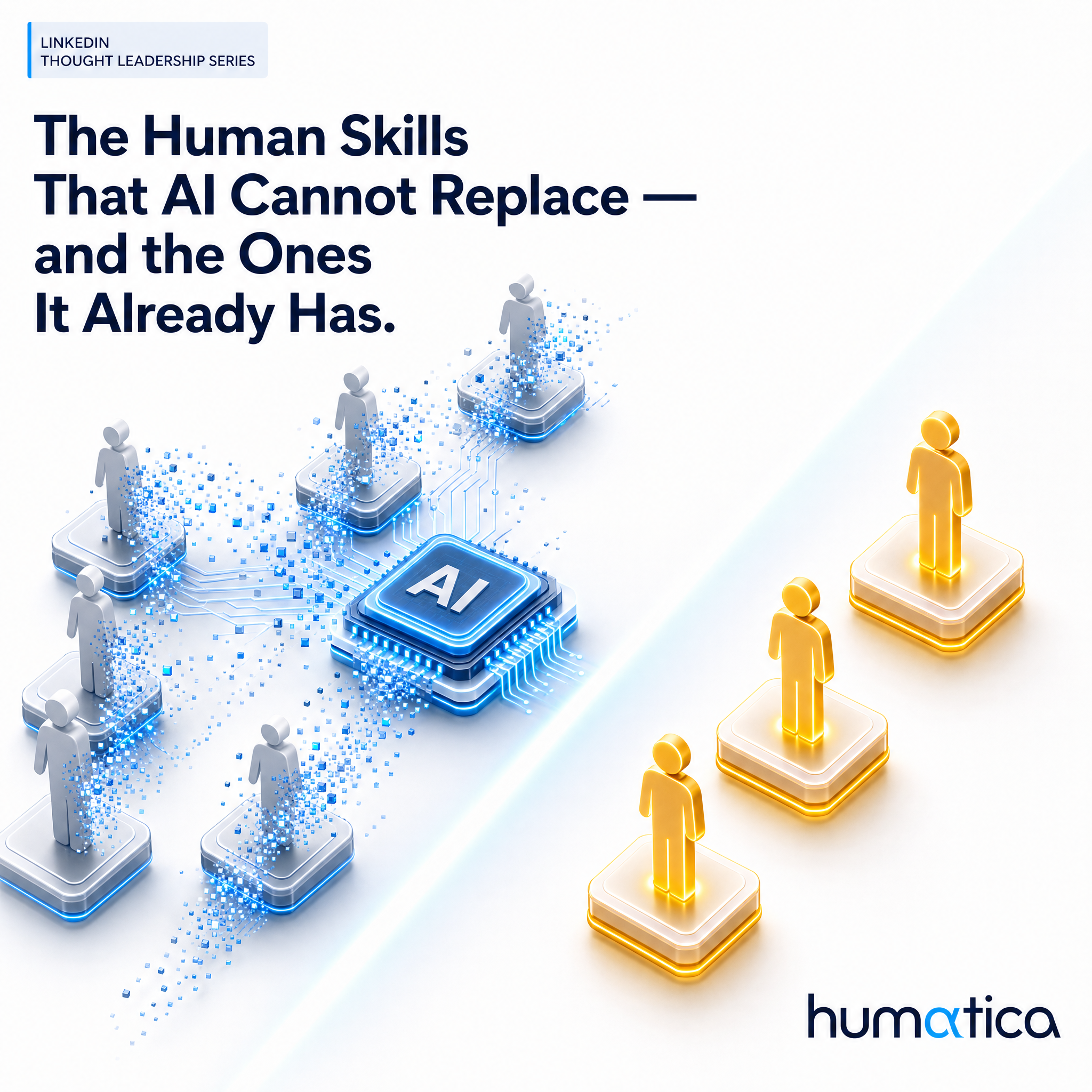
The Human Skills That AI Cannot Replace — and the Ones It Already Has
 By Bryan Turner


The debate about which human skills AI will replace has generated more anxiety than clarity. Much of this anxiety is produced by a framing error: treating AI’s impact on skills as a binary — replaced or not replaced — when in reality the impact is more nuanced, more gradual, and ultimately more actionable.
This article offers a different framework, built not on speculation about future AI capabilities but on an honest assessment of what AI is demonstrably doing right now in business contexts. The framework has four categories: skills that AI has already effectively matched or exceeded, skills that AI is actively augmenting but not replacing, skills where AI is improving but significant human advantage remains, and skills that are genuinely and durably human. Understanding these categories clearly has practical implications for how organisations invest in their people, how individuals invest in themselves, and how work is redesigned for an AI-augmented world.
What AI Has Already Matched or Exceeded
Several categories of knowledge work that were previously the preserve of skilled professionals have been matched or exceeded by current AI in specific, well-defined contexts. Pattern recognition across large datasets — identifying correlations, anomalies, and trends in structured data — is one. Humans are good at this in small-scale contexts; AI is extraordinarily better at scale. This affects financial analysis, quality control, medical diagnostics, and fraud detection, among many others.
Information synthesis — reading multiple sources, extracting relevant information, and producing a coherent summary — is another. An AI system can synthesise hundreds of documents in the time it takes a human analyst to read ten, and in many contexts the quality of the synthesis is comparable. This affects research, due diligence, competitive intelligence, and knowledge management.
Structured text generation — producing reports, correspondence, first-draft documents, and communications according to clear parameters — is a third. Most routine professional writing in business contexts falls into this category: variance reports, client communications, policy documents, meeting minutes. AI performs these tasks well, at speed, and at essentially zero marginal cost.
The honest implication is that individuals and organisations whose primary value-add lies in these areas face real pressure. This is not a future threat — it is present reality.
Skills AI is Augmenting but Not Replacing
A second category of skills is being powerfully augmented by AI: the human professional performs significantly better with AI assistance than without, but the human remains essential. Structured analytical reasoning — forming hypotheses, designing tests, interpreting ambiguous results, drawing conclusions — is one example. AI can perform each of these steps, but a skilled human working with AI produces better outcomes than either alone.
Complex technical execution — writing production code for complex systems, designing intricate engineering solutions, executing nuanced surgical procedures — is another. AI tools dramatically accelerate and improve the quality of the work, but judgment, experience, and tacit knowledge remain human contributions that are not yet replicable. The key feature of augmented skills is that they grow in value in an AI world: the human who uses AI tools to multiply their analytical or technical output is more valuable, not less.
What Remains Genuinely Human
The category that matters most for individual and organisational investment is the genuinely and durably human skills — capabilities where AI is currently poor and where the gap is likely to persist, for structural reasons rather than merely technical ones.
Deep relational intelligence is the most important of these. Building real trust, exercising genuine empathy, navigating interpersonal conflict, motivating individuals who are uncertain or resistant — these capabilities require shared human experience, mutual vulnerability, and contextual emotional attunement that AI can simulate convincingly but cannot replicate structurally. The people who lead, sell, coach, and care with exceptional relational intelligence will be more valuable in an AI world, not less.
Authentic moral accountability is another. When a consequential decision has gone wrong, the response that restores trust is a human being taking genuine personal responsibility — not an AI system or a process explanation. The capacity for moral agency — to own decisions, to bear accountability, to exercise ethical judgment in situations where the rules are insufficient — is uniquely human and uniquely valuable.
Genuine creative synthesis — producing truly novel ideas that represent a departure from existing patterns, rather than sophisticated recombination of prior work — is a third. AI is extraordinary at pattern-based creativity: synthesising existing approaches in new configurations, generating variations on themes, and producing high-quality work within established genres. It is not yet capable of the kind of disruptive creative leap that opens genuinely new territory.
High-stakes judgment in genuinely novel situations is the fourth. The situations where human judgment is most essential are precisely those where historical patterns are inadequate guides — genuine crises, unprecedented market shifts, entirely novel ethical dilemmas. AI trained on past data has no inherent advantage over humans in these situations and may be actively disadvantageous.
The Investment Imperative
The practical implication of this framework is clear. Individuals should be investing most heavily in the second and third categories: augmented skills that grow in value when combined with AI capability, and durable human skills that AI cannot replicate. The people who will thrive in an AI-augmented world are those who use AI to multiply their output in the augmented category while deepening their distinctly human capabilities in the durable category.
For organisations, the investment implication is equally clear: reskilling programmes should focus on AI fluency (to improve performance in augmented skills) and on the relational, ethical, and creative capabilities that remain distinctly human. The programmes that focus primarily on technical AI skills are necessary but insufficient. The programmes that develop the full range of human-AI complementarity are those that will produce genuinely AI-ready workforces.
Related Insights
Why 80% of AI Pilots Never Scale — and What the Successful 20% Do Differently
The AI pilot graveyard is large, and it is growing. Across the organisations we have worked with and the research we have reviewed, the pattern…
Read more
AI and Competitive Advantage: Why the Moat Is the Data, Not the Model
Every board strategy conversation about AI now includes a version of the same question: how do we use AI to get ahead, rather than just…
Read more
AI Risk: The 10 Things Every Board Should Know (and Most Don’t)
Corporate governance has always lagged behind the risks it is meant to manage. Boards develop oversight frameworks for risks after those risks have become embedded…
Read more
Subscribe to our Monthly Newsletter and other News Updates
Receive our news and valuable perspectives on organizational effectiveness each month.
