20 years helping business leaders deliver alpha. View our success stories

20 years helping business leaders deliver alpha. View our success stories
 By Claudio Limacher


In many organizations, strategy promises growth, efficiency, and innovation—but day-to-day execution tells a different story. Decisions drag. Silos persist. Accountability blurs. Leaders work harder without seeing the expected results. In most cases, the root cause is not the strategy itself, but the operating model that sits beneath it. As companies scale, transform, or face new competitive pressures, past structures and ways of working simply stop supporting what the business is trying to achieve. When the operating model is no longer fit for purpose, frictions build silently until financial performance suffers. [1], [2]
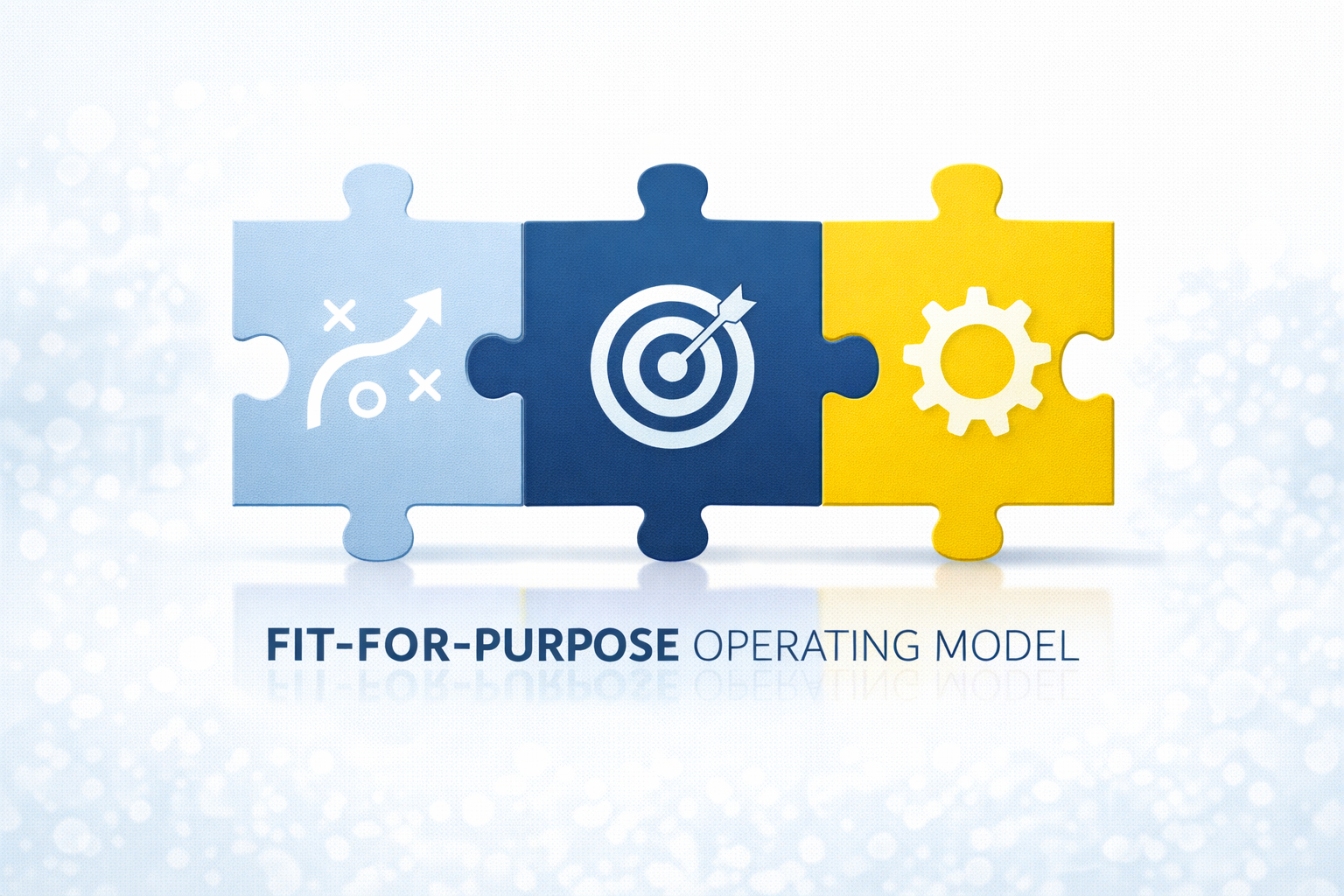
A Target Operating Model (TOM) is the blueprint that connects strategy to execution. It defines how an organization creates value: how decisions are made, how teams collaborate, how roles are structured, and how technology supports the flow of work. While org-charts describe who reports to whom, the operating model describes how work actually happens day to day. When this “how” is misaligned with the strategic ambitions of the business, even the best plans struggle to take off. [3], [4], [5]
Today’s environment makes TOM alignment more important than ever. Shifts in technology, new investor expectations, digital disruption, and the accelerating impact of AI mean that operating models age faster than in the past. Structures designed for stability are suddenly expected to deliver agility. Consolidated teams, built for scale, are asked to collaborate across boundaries. Leaders inherit processes that no longer match the company’s goals. The result: strategy–execution gaps, duplicated work, delays, and leadership teams spending more energy on firefighting than on advancing the business. [1], [6]
Yet a well-designed operating model can be a powerful multiplier. When roles are clear, decision rights are streamlined, governance is simple, and teams collaborate effectively, organizations can dramatically accelerate execution—improving speed, quality, and accountability. Research shows that companies with aligned operating models can improve execution pace by up to 10x and lift both productivity and customer satisfaction. The right TOM not only supports today’s strategy—it creates resilience and adaptability for tomorrow. [3]
But creating a great TOM on paper is not enough. The real challenge lies in implementation. Many TOM initiatives fail because leaders underestimate the changes required in behaviors, capabilities, systems, and metrics. Without a compelling case for change, genuine engagement of the organization, and clear alignment of KPIs and incentives, even well-designed models fall short. Successful TOM redesigns require thoughtful change management, leadership alignment, rigorous project discipline, and transparent communication. And increasingly, they require a perspective on how AI and automation are reshaping roles, workflows, and governance at their core. [7], [6], [8]
Given the escalating complexity of modern business, operating model redesign is becoming a “must-have” necessity, rather than a one-off transformation. Companies are revisiting their TOM assumptions more frequently and ensuring that changes are fast, robust, and tied to tangible performance outcomes.
This initial article sets the stage for a three-part deep dive into designing and implementing a fit-for-purpose TOM:
Part I – Recognizing When Your Operating Model No Longer Fits
Part II – Designing a TOM That Truly Enables Strategy
Part III – Implementing the TOM: Turning Design into Lasting Results
Together, the series provides a practical roadmap for leaders seeking to turn strategy into results quickly, sustainably, and at scale.

Liquidity has become the defining constraint in today’s private equity markets. Where timing and financial engineering once drove distributions, funds are now facing longer holding…
Read more

Private equity investors and executive teams rightly focus on operating model design as a core lever for value creation. The right structure can accelerate growth,…
Read more

In today’s private equity landscape, the classic levers of value creation are no longer enough. As markets evolve and competition intensifies, governance is emerging…
Read more
Erhalten Sie jeden Monat Neuigkeiten und wertvolle Perspektiven zu Themen der organisatorischen Effektivität