


AI and Competitive Advantage: Why the Moat Is the Data, Not the Model
 By Bryan Turner


Every board strategy conversation about AI now includes a version of the same question: how do we use AI to get ahead, rather than just to keep up? It is the right question. But most of the answers being given in those conversations focus on the wrong thing.
Strategy discussions about AI tend to concentrate on which AI models to adopt, which platforms to deploy, and which AI vendors offer the most capability. These are important procurement decisions. But they are not strategy decisions — because they are decisions that every competitor can make on essentially equal terms. The best foundation models in the world are available to every organisation for a few cents per API call. A competitive advantage built on accessing the same AI models as your competitors is no advantage at all.
Where Sustainable AI Advantage Actually Comes From
Sustainable competitive advantage in an AI-enabled world comes from three sources — and only three.
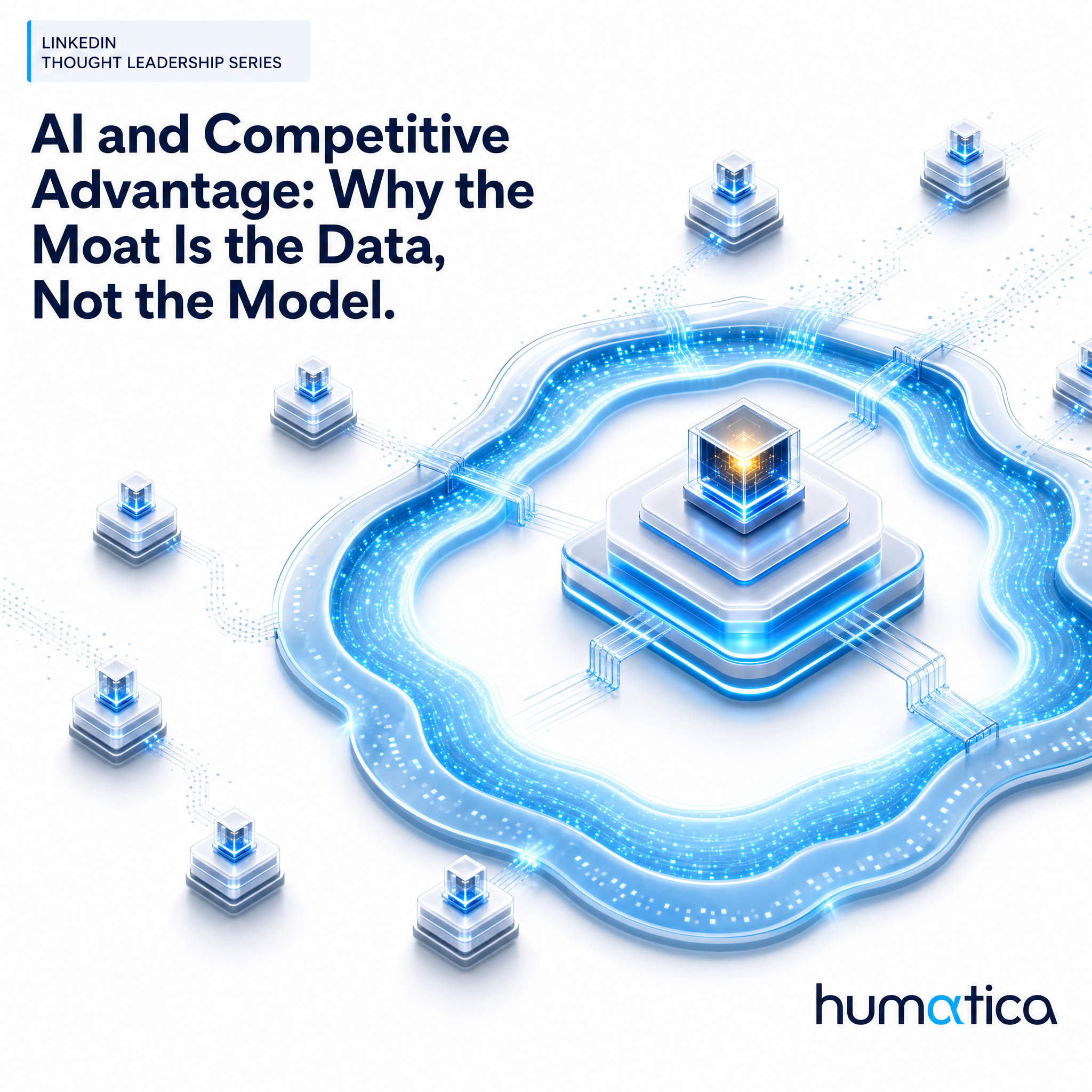
The first is proprietary data. Data that competitors cannot easily access or replicate creates an AI advantage that is structural and durable. An organisation that has accumulated years of proprietary customer interaction data can train AI systems that understand its customers in ways no new entrant can immediately replicate. A manufacturer with sensors across every piece of equipment has operational data that cannot be bought from a vendor. A professional services firm with decades of project and outcome data has intellectual capital that cannot be commoditised. The organisations that recognise proprietary data as a strategic asset — and actively manage, protect, and invest in it — are building AI moats that matter.
The second source of sustainable advantage is superior AI-enabled workflows. The value of an AI tool is determined not just by the quality of the model but by how well it is integrated into the processes and decisions of the organisation. An organisation that has invested in deeply integrating AI into its core workflows — not just using AI to improve individual tasks, but redesigning processes around AI’s capabilities — will create productivity and quality advantages that are not immediately replicable even by a competitor who acquires the same technology. The workflow integration is the value, not the model.
The third source is organisational learning speed — the capacity to experiment, learn, and adapt faster than competitors. AI is a rapidly evolving field: the organisations that develop the organisational muscles for rapid AI deployment and iteration will consistently exploit new capabilities before their competitors. This is not primarily a technology advantage — it is a human and cultural one. It requires the AI literacy, the governance agility, and the change management capability to move from identifying an AI opportunity to deploying it at scale in weeks rather than months.
Industry-Specific Dynamics: Winner-Takes-All vs. Rising Tide
AI competitive dynamics are not uniform across industries. In some sectors, AI is creating winner-takes-all or oligopolistic dynamics — where the organisations with the best AI compound their advantage at a rate that smaller players cannot match. Digital platforms, financial services, and logistics are all showing early signs of this pattern. The AI leaders in these sectors are widening their advantage faster than the followers can close the gap.
In other sectors, AI is more of a rising tide — a technology that improves the performance of all players roughly equally, with the competitive order broadly preserved. Professional services, healthcare delivery, and education are showing more of this pattern, at least in the near term, because the human-relational and judgment-intensive elements of these businesses remain significant and are not yet AI-differentiable.
Understanding which dynamic applies to your sector is a prerequisite for calibrating the urgency of AI investment. In winner-takes-all sectors, the cost of being a fast follower may already be too high. In rising tide sectors, there is more time — but that time should not be mistaken for licence to be slow.
The Data Strategy Imperative
The practical implication of the moat-is-the-data argument is that every AI strategy must begin with a data strategy. This means asking not just ‘what data do we have?’ but ‘what data could we create, acquire, or aggregate that competitors cannot easily replicate?’ It means treating data governance not as a compliance function but as a strategic capability. And it means making deliberate investment decisions about data collection, enrichment, and structuring that may not have an immediate return but that will determine AI competitive position three to five years from now.
The organisations that are thinking about data strategy this way — as the foundation of AI competitive advantage rather than an IT infrastructure question — are the ones that will compound their AI advantages over time. The ones treating data as a byproduct of their operations, rather than a strategic asset, are building on sand.
The Build, Buy, Partner Decision
Every AI strategy requires a considered answer to the build-buy-partner question across different capabilities. The general principle is: use commodity AI (accessible foundation models and platforms) for commodity tasks, and invest in proprietary AI capability where the competitive differentiation comes from unique data and unique workflow integration.
Few organisations have the engineering capability to build foundation models — nor should they. But every organisation can and should develop the capability to fine-tune models on proprietary data, to design AI-integrated workflows that competitors cannot easily copy, and to develop the organisational capacity to exploit new AI capabilities as they emerge. This last capability — the organisational learning speed — may be the most important AI investment of all.
Related Insights
AI Risk: The 10 Things Every Board Should Know (and Most Don’t)
Corporate governance has always lagged behind the risks it is meant to manage. Boards develop oversight frameworks for risks after those risks have become embedded…
Read more
The CFO’s AI Imperative: From Efficiency Gain to Strategic Transformation
Finance has always been an early adopter of technology — from double-entry bookkeeping to spreadsheets to ERP to cloud-based analytics. And finance has always been…
Read more

Building the AI-Ready Organisation: Why Technology is the Easiest Part
When most organisations begin an AI readiness assessment, they start with technology. Do we have a modern cloud infrastructure? A unified data platform? Access to…
Read more
Abonnieren Sie unseren monatlichen Newsletter und andere News Updates
Erhalten Sie jeden Monat Neuigkeiten und wertvolle Perspektiven zu Themen der organisatorischen Effektivität