20 years helping business leaders deliver alpha. View our success stories

20 years helping business leaders deliver alpha. View our success stories
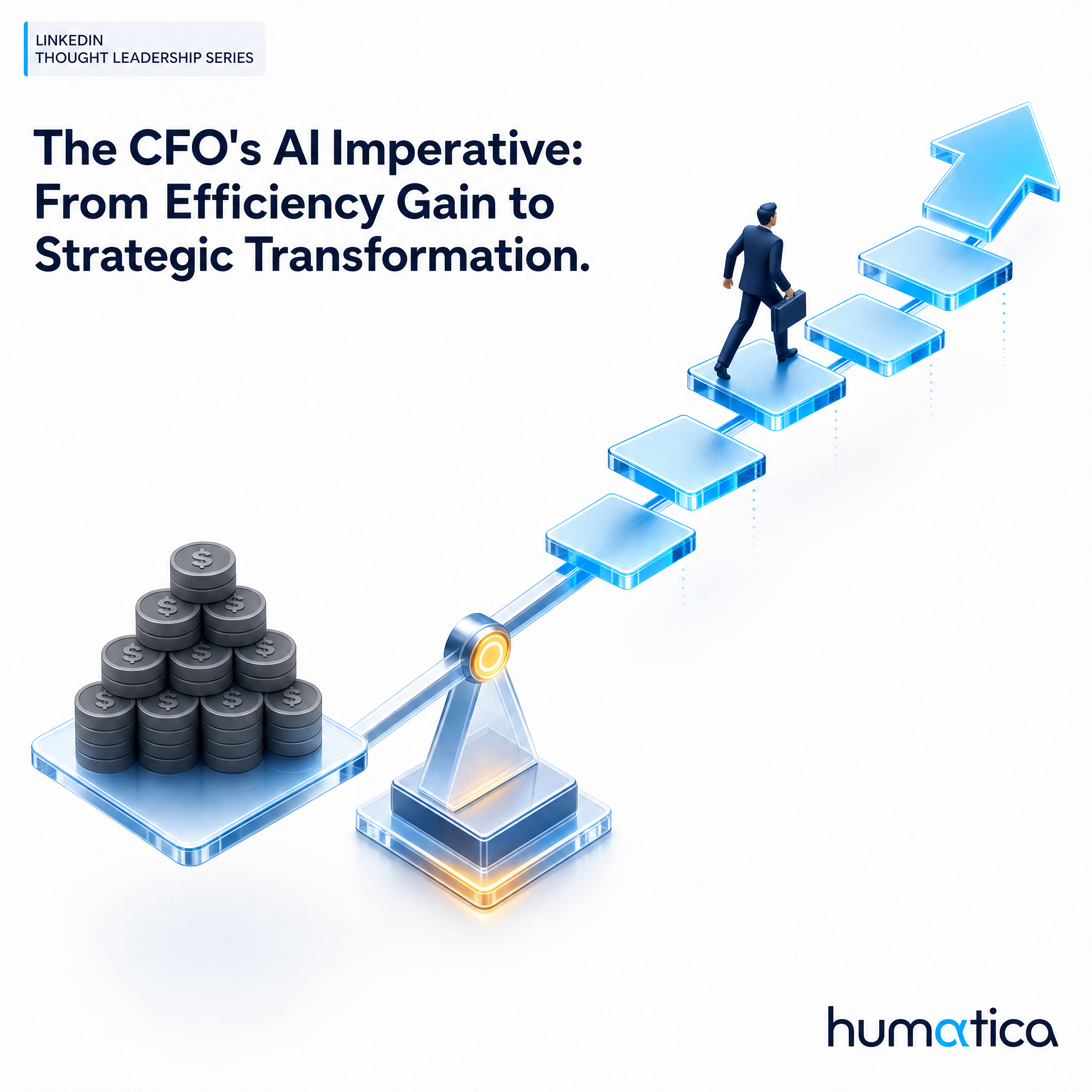
 By Bryan Turner


Finance has always been an early adopter of technology — from double-entry bookkeeping to spreadsheets to ERP to cloud-based analytics. And finance has always been the function tasked with evaluating the return on every other function’s technology investment. This creates a particular irony when it comes to AI: the CFOs who are most rigorous about demanding business cases for AI investment in other functions are often the ones investing least ambitiously in AI within their own.
This article is not primarily about AI automation in finance — though the automation opportunity is substantial and well-documented. It is about a more fundamental question: as AI takes over an increasing proportion of the analytical, reporting, and process management work that currently defines the finance function, what does finance become? And what must CFOs do now to build the finance function of the future rather than defend the one they currently have?
The business case for automating transactional finance processes with AI is compelling and extensively evidenced. Accounts payable automation — intelligent invoice receipt, data extraction, purchase order matching, and payment scheduling — can reduce cost per invoice from the industry average of £8-12 to under £0.50, with processing cycles measured in hours rather than days. Month-end close processes that currently take two to three weeks can be compressed to days, with AI handling the reconciliation, variance detection, and initial commentary. Management reporting packs that require teams of analysts to assemble can be generated automatically, with AI producing the first-draft narrative alongside the numbers.
For most large finance functions, the total productivity opportunity from process automation alone represents a 20-40% reduction in transaction processing headcount. Yet the majority of finance functions have deployed automation incrementally — targeting one or two processes — rather than systematically. The reason is almost always governance and risk aversion rather than economics: finance teams are appropriately cautious about automating processes where errors have material consequences. The solution is better governance of the automation, not slower adoption.
Beyond process automation, AI is transforming the analytical core of finance. Financial Planning & Analysis — traditionally a backward-looking function that produced detailed variance explanations of what happened last month — is being redesigned around real-time predictive capability. AI models trained on historical patterns and fed with real-time operational data can now produce rolling forecasts that update continuously, flagging emerging variances before they become reported problems and allowing management to intervene proactively.
The implications for the FP&A function are profound. When the forecast is generated automatically and updated in real time, the analyst’s job shifts from building and maintaining the forecast to interpreting it, challenging it, and helping business leaders understand the decision implications. This is a more valuable job — but it requires a different skill set than traditional FP&A, and it requires that analysts have the commercial acumen to be genuinely useful business partners rather than sophisticated spreadsheet operators.
The transformational implication of AI for the CFO role is not primarily about efficiency. It is about strategic positioning. The CFO who frees their function from the burden of process management and backward-looking reporting gains something invaluable: the capacity to be a true strategic partner to the CEO and the business.
The AI-enabled finance function can provide real-time financial intelligence that was previously impossible — not just what has happened, but what is likely to happen and what the financial implications of different strategic choices are. It can model scenarios at a speed and granularity that transforms strategic planning from an annual exercise into a continuous capability. It can identify financial risks and opportunities embedded in operational data long before they surface in reported numbers.
The CFOs who will define the role for the next decade are those who see this strategic potential clearly and build deliberately toward it — investing in the data infrastructure, the analytical capabilities, and the human talent that will make it real. Those who continue to define their role primarily through the ownership of financial processes will find those processes increasingly automated, their teams smaller, and their strategic relevance diminished.
First: commission an honest audit of which finance processes should be automated and on what timeline. Apply the same rigour to your own function’s business cases that you apply to every other function’s.
Second: redefine the capabilities your finance team needs to develop. Analytical storytelling, commercial judgement, and AI literacy are becoming as important as technical accounting competence. Invest in building them.
Third: personally commit to AI literacy. CFOs who use AI tools in their own work — for research, scenario modelling, communication — are dramatically more credible advocates for AI transformation in their function and across the business.
Fourth: redesign your FP&A operating model around real-time predictive capability. This is not an incremental improvement to existing processes — it is a fundamental redesign of what planning and analysis means.
Fifth: position yourself as the AI strategy’s financial architect for the whole organisation. The CFO’s role in AI investment governance — capital allocation, benefit realisation, risk management — is one of the most important and underplayed strategic contributions available right now.

When most organisations begin an AI readiness assessment, they start with technology. Do we have a modern cloud infrastructure? A unified data platform? Access to…
Read more
The evidence that AI improves individual productivity is now overwhelming. Across dozens of controlled studies, knowledge workers with AI tools consistently outperform those without —…
Read more
Every significant technological shift in economic history has ultimately changed the shape of organisations — not just the tools they use, but their structures, hierarchies,…
Read more
Erhalten Sie jeden Monat Neuigkeiten und wertvolle Perspektiven zu Themen der organisatorischen Effektivität