20 years helping business leaders deliver alpha. View our success stories

20 years helping business leaders deliver alpha. View our success stories

 By Bryan Turner


When most organisations begin an AI readiness assessment, they start with technology. Do we have a modern cloud infrastructure? A unified data platform? Access to frontier language models? These are real prerequisites and they matter. But in Humatica’s work with organisations across multiple sectors, they are almost never the primary reason that AI programmes fail to deliver.
The primary reasons are organisational: poor data quality and governance that makes AI outputs unreliable; AI literacy gaps at every level that prevent tools from being used effectively; leadership mindsets that treat AI as an IT initiative rather than a business transformation; operating model rigidities that prevent AI from changing how work actually gets done; and cultural environments where experimentation is punished and failure is not tolerated. Technology readiness is necessary but insufficient. Organisational readiness is the variable that determines success.
We have developed a six-dimension AI readiness framework that captures the full set of organisational conditions required for AI to deliver sustained value at scale.
The first dimension is data quality and governance. AI systems are only as good as the data they learn from and operate on. Organisations with fragmented, inconsistent, or poorly governed data assets will find that AI amplifies their data problems rather than solving them — producing authoritative-sounding outputs that are based on unreliable inputs. Getting data quality right is not glamorous, but it is foundational. Organisations that invest in data governance before AI deployment consistently outperform those that try to do both simultaneously.
The second dimension is technology infrastructure. Cloud scalability, API-first architecture, and modern data platforms are the technical prerequisites for AI at enterprise scale. Legacy monolithic systems that cannot integrate with AI tools create the ‘integration abyss’ that traps AI pilots in perpetual proof-of-concept. This is the dimension most organisations are investing in most actively, and it is the one where they score most highly.
The third dimension is AI literacy across every level of the organisation. This does not mean every employee needs to understand how large language models work — it means every employee needs to understand what AI can and cannot do in their specific context, how to use AI tools safely and effectively, and how to critically evaluate AI outputs. The current state in most organisations is concerning: surveys consistently show that fewer than 25% of employees feel confident using AI tools in their day-to-day work. Closing this gap is not a matter of providing access to tools — it requires structured learning, practice, and ongoing reinforcement.
The fourth dimension is leadership mindset and commitment. The most important determinant of AI transformation success is whether senior leaders personally believe in and are committed to AI adoption — not as a project to delegate to the CTO, but as a strategic priority they own, resource adequately, and role-model in their own working practices. The leadership teams that are getting the most from AI are those where the CEO, CFO, and other C-suite members are themselves using AI tools, talking openly about what they are learning, and holding the organisation accountable for AI progress.
The fifth dimension is cultural tolerance for experimentation. AI deployment is inherently experimental: not every AI initiative will succeed, and organisations that treat failure as a performance issue will find their people avoiding the experimentation that is essential for learning. The organisations making the fastest AI progress are those with genuine psychological safety around trying new approaches — where failure is discussed openly, learnings are shared, and the value of a failed experiment is recognised.
The sixth dimension — and the one most often neglected — is process and operating model design. The single most common failure mode in AI deployment is bolting AI tools onto unchanged processes and unchanged ways of working. AI used in this way can improve individual task efficiency, but it cannot create systemic transformation. Systemic transformation requires redesigning the process around AI’s capabilities: changing the sequence of activities, removing steps that AI makes redundant, redesigning roles to focus human effort on the tasks where humans add most value, and building AI into the decision rights and governance of the organisation.
This process redesign work is harder and less exciting than deploying AI tools, and it is frequently deferred. The organisations that invest in it are those that move from incremental efficiency gains to genuine transformation.
The most useful starting point for any AI readiness initiative is an honest diagnostic against these six dimensions — rating each on a scale of current maturity and identifying the most significant gaps. In our experience, this diagnostic almost always produces a clear prioritisation: organisations that have addressed dimensions one, three, four, five, and six can deploy AI rapidly and capture significant value; those that have not will find their technology investments generating disappointingly little return.
The diagnostic is also useful for identifying sequencing: most organisations should not try to address all six dimensions simultaneously. The right order depends on the specific AI applications being targeted and the current baseline, but data quality and leadership commitment are almost always prerequisites before the other dimensions can be addressed effectively.
The organisations that will win the AI race are not the ones with the biggest technology budgets. They are the ones that have done the harder, less visible work of becoming organisationally ready to exploit the technology. That work starts with an honest assessment of where you actually are.

The evidence that AI improves individual productivity is now overwhelming. Across dozens of controlled studies, knowledge workers with AI tools consistently outperform those without —…
Read more
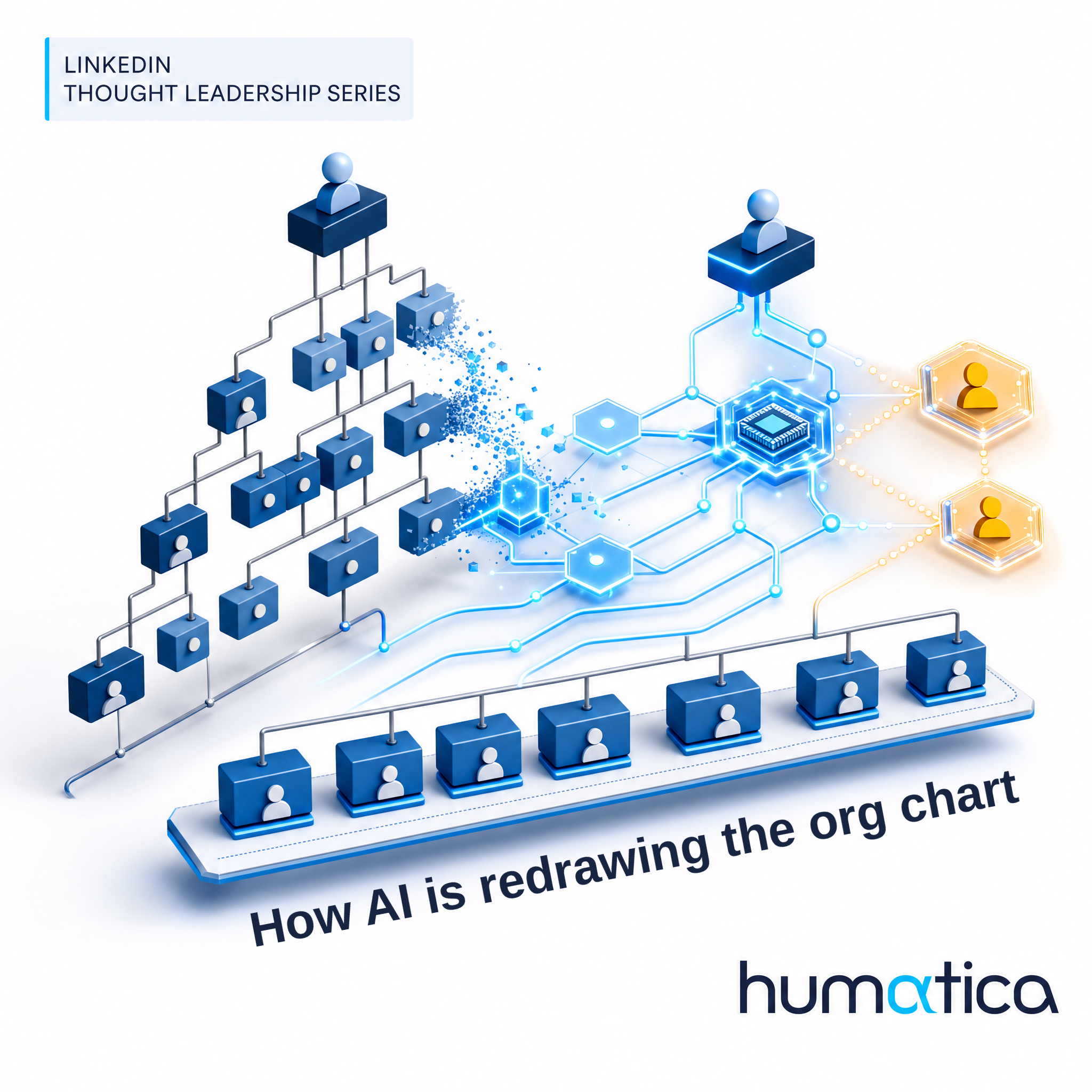
Every significant technological shift in economic history has ultimately changed the shape of organisations — not just the tools they use, but their structures, hierarchies,…
Read more

This is the final article in a three-part series on designing and implementing a fit-for-purpose Target Operating Model. In Part I, we explored how to…
Read more
Erhalten Sie jeden Monat Neuigkeiten und wertvolle Perspektiven zu Themen der organisatorischen Effektivität