20 years helping business leaders deliver alpha. View our success stories

20 years helping business leaders deliver alpha. View our success stories
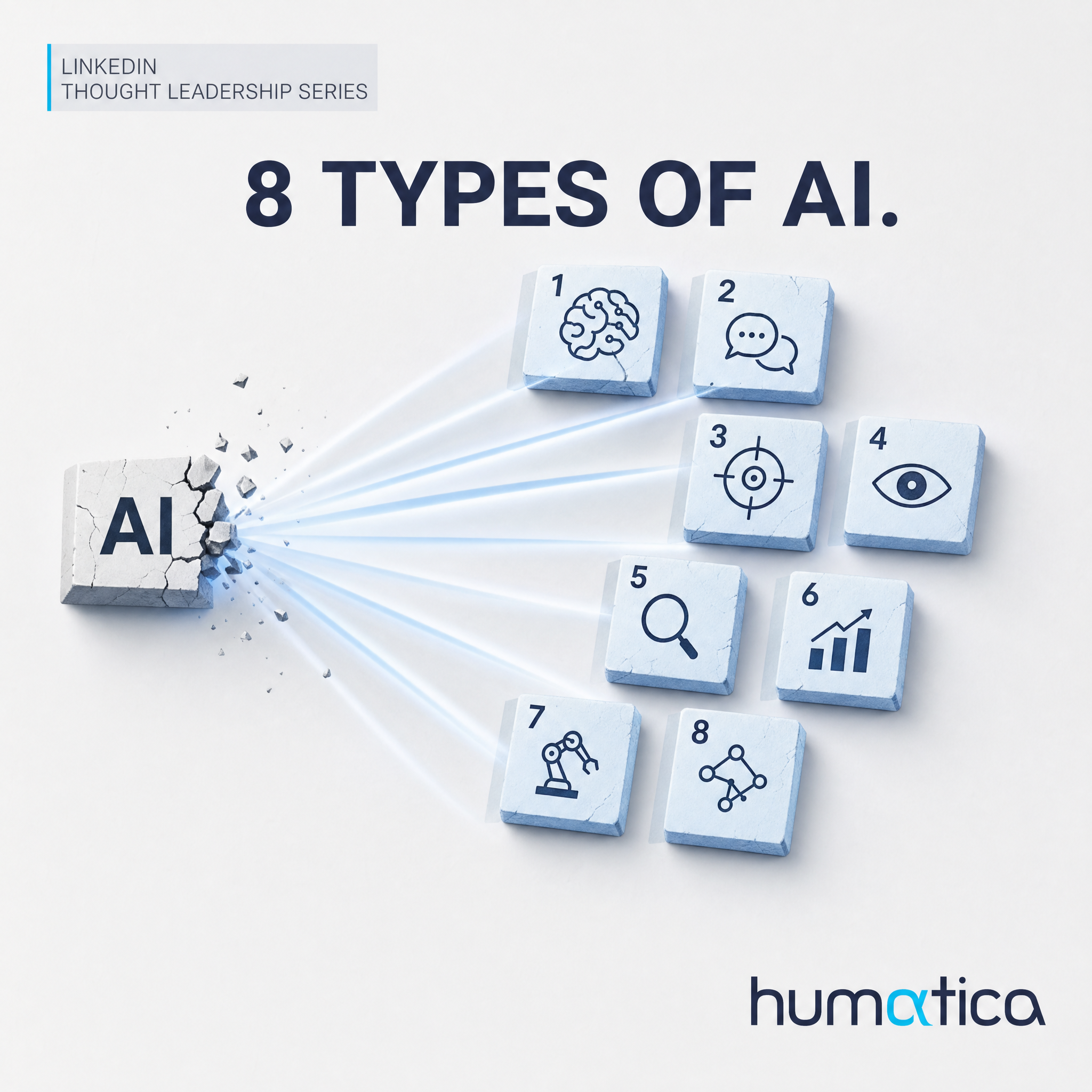
 By Bryan Turner


One of the most persistent sources of confusion in business conversations about AI is the habit of treating ‘AI’ as a single, monolithic technology. It is not. Artificial Intelligence is a family of eight distinct capability types, each with a different underlying mechanism, a different set of proven applications, and a different economic profile. Conflating them leads to misallocated investment, wrong vendor choices, unrealistic expectations, and strategic blind spots.
The business leaders who are getting the most from AI are those who can articulate exactly which types they are deploying, where, and why — and who can identify the types they are underexploiting. This article provides the framework.
Generative AI uses Large Language Models and related architectures to create original content — text, code, images, audio, and video. It is the AI type that has attracted the most attention since the launch of ChatGPT in late 2022, and with good reason: it is accessible, versatile, and immediately useful across almost every business function. Copywriting, report drafting, code generation, presentation creation, legal document drafting, and customer communication are all areas where Generative AI is delivering measurable productivity improvements.
The risk with Generative AI is that it attracts disproportionate investment relative to other AI types, precisely because it is so visible and easy to demonstrate. It is also the AI type that requires the most careful governance: hallucination (plausible but incorrect outputs), intellectual property risk from training data, and the potential for misuse in external communications are all real concerns.
Predictive Analytics AI analyses historical data to forecast future outcomes, classify inputs, and detect anomalies. It is arguably the most commercially mature category of business AI: credit scoring, fraud detection, demand forecasting, and churn prediction have been powered by predictive ML for over a decade. Unlike Generative AI, which creates content, Predictive AI produces scores, probabilities, and classifications that feed into decision-making.
The opportunity that most organisations are still underexploiting is the combination of modern ML approaches with richer, more granular operational data. Real-time predictive maintenance — moving from scheduled to condition-based maintenance — is one example where the ROI is well-documented but adoption remains lower than the economics warrant.
Process Automation AI combines traditional Robotic Process Automation with intelligent document processing, optical character recognition, and machine learning to execute structured and semi-structured business processes without human intervention. Accounts payable automation, employee onboarding workflow orchestration, and compliance document processing are all mature, high-ROI applications.
This is the AI type with the shortest path from deployment to measurable financial return. Invoice automation, for example, can reduce cost per invoice from £8-12 to under £0.50 — a return that can be calculated with precision and realised within months. Organisations that have not yet automated their highest-volume, most structured processes are leaving demonstrable value on the table.
Computer Vision AI interprets visual data — images, video, documents — to extract meaning and drive action. Its applications are concentrated in operations (manufacturing quality inspection, warehouse management, worker safety monitoring) and research (medical imaging, materials science, satellite analysis). In manufacturing environments, AI quality inspection systems are achieving defect detection rates that human inspection cannot match, while operating continuously and generating rich data about production quality trends.
Computer Vision is the AI type most likely to be underestimated by service-sector organisations and overestimated by asset-light businesses. Its transformational potential is genuinely sector-specific.
Conversational AI enables natural language dialogue between humans and systems — across text and voice. Modern conversational AI, powered by LLMs rather than the rule-based chatbots of a decade ago, can handle complex, multi-turn interactions, integrate with back-end systems, and resolve a substantial proportion of customer and employee queries without human involvement. Mature customer service deployments are resolving 40-70% of tier-one contacts without a human agent.
The boundary between Conversational AI and Generative AI is narrowing rapidly as LLMs become the engine behind most dialogue systems. The distinction that remains meaningful is the deployment context: Conversational AI is specifically about interface — the channel through which humans and systems interact.
Optimisation AI finds the best solution to a complex, constrained problem — how to route thousands of vehicles, price millions of products dynamically, allocate capital across a portfolio, or schedule an entire workforce. It combines operations research techniques with machine learning to solve problems at a scale and speed that is computationally impossible for humans. The ROI data for supply chain optimisation applications is particularly compelling: leading implementations show 15-30% reductions in logistics cost and inventory.
This is the most underinvested major AI category in most organisations, primarily because it lacks the accessible interface of Generative and Conversational AI. The value it creates is substantial, but it requires more sophisticated problem framing and more specialised implementation capability.
Recommendation AI predicts what a specific individual will find most valuable — a product, a piece of content, a next best action, a learning module — and surfaces it at the right moment. It is the engine behind Netflix, Amazon, and Spotify, and it is increasingly embedded in enterprise applications: sales CRM systems, HR learning platforms, customer service knowledge bases, and e-commerce platforms.
The key insight about Recommendation AI is that its accuracy scales directly with data volume. The more behavioural data available, the better the recommendations. This creates a compounding advantage for organisations that deploy early and build rich data assets.
Agentic AI is the frontier: autonomous AI systems that receive a goal, develop a plan, use tools, take actions, and return a completed outcome. Rather than answering a question or generating content, an agent completes a task. Research and synthesis, due diligence, supply chain exception management, software development, and complex customer service resolutions are all areas where agentic deployments are moving from prototype to production.
Agentic AI represents the most disruptive near-term development in business AI. It is also the AI type that requires the most rigorous governance framework — autonomous systems making consequential decisions demand clear accountability structures, robust testing, and explicit human oversight protocols.
The most useful output of this taxonomy is not a catalogue of AI types — it is a portfolio perspective on your organisation’s current AI position. Most organisations, if they map their AI investments against these eight types, will find significant concentration (typically in Generative AI and to a lesser extent Predictive and Automation) and significant gaps (typically in Optimisation and Agentic).
A rigorous AI portfolio review — asking where each type could create value in your specific business, where you currently sit, and where the investment gaps are — is one of the highest-value strategic exercises any leadership team can undertake right now. The organisations that do this well will allocate AI investment more deliberately and build a more durable and diverse AI advantage.

When most organisations begin an AI readiness assessment, they start with technology. Do we have a modern cloud infrastructure? A unified data platform? Access to…
Read more
The evidence that AI improves individual productivity is now overwhelming. Across dozens of controlled studies, knowledge workers with AI tools consistently outperform those without —…
Read more
Every significant technological shift in economic history has ultimately changed the shape of organisations — not just the tools they use, but their structures, hierarchies,…
Read more
Erhalten Sie jeden Monat Neuigkeiten und wertvolle Perspektiven zu Themen der organisatorischen Effektivität